
Dada Almanach 1920: Richard Huelsenbeck's Anthology of the Movement

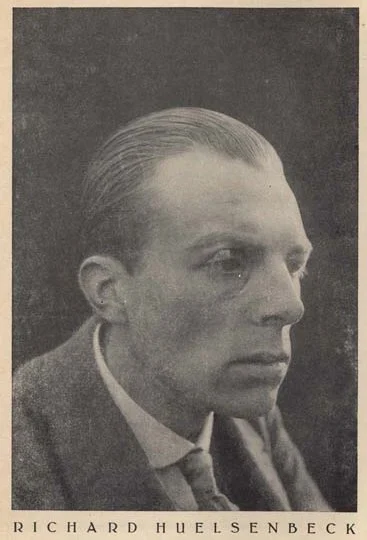
Unknown author Unknown author, Public domain, Wikimedia Commons
The Dada Almanach, edited by Richard Huelsenbeck and published in Berlin by Erich Reiss in 1920, is the movement's first major anthology. It gathers statements, poems, and reproductions by Ball, Arp, Tzara, Hausmann, Grosz, and Huelsenbeck, and remains a key primary source for Berlin Dada.
What the Dada Almanach Was
The Dada Almanach is a single-volume anthology published in Berlin by Erich Reiss in 1920. Unlike a periodical issue, it was a book meant to collect statements from the movement in one place. Richard Huelsenbeck served as editor and drew together contributors from Zurich Dada and Berlin Dada. The volume mixes manifestos, poems, prose, and reproductions, making it a reference point for what Dada had become in the years after the Cabaret Voltaire.
Why Huelsenbeck Edited It
Richard Huelsenbeck's Dada Almanach grew out of his position inside the movement. He had taken part in the Cabaret Voltaire in Zurich and, by 1917, had returned to Berlin, where Dada took a more political and satirical turn. His preface frames the volume as a panorama of Dada activity rather than a single group's statement. That editorial position allowed him to include figures from Zurich, Berlin, and Paris. The Almanach therefore reads as an attempt to hold the movement together in print at a moment when it was splitting into local tendencies. Huelsenbeck's own contributions sit alongside those of Ball, Tzara, and the Berlin circle, which reflects that bridging role.
Inside the 1920 Almanach
The 1920 volume collects manifestos, poems, texts, and reproductions. The International Dada Archive maintains a Dadaist index that confirms the contributors below, including the figures most often associated with the Almanach.
| Contributor | Known role in Dada |
|---|---|
| Richard Huelsenbeck | Editor; Berlin Dada |
| Hugo Ball | Co-founder of the Cabaret Voltaire |
| Tristan Tzara | Zurich Dada |
| Jean (Hans) Arp | Zurich Dada artist and poet |
| Raoul Hausmann | Berlin Dada |
| George Grosz | Berlin Dada |
| Johannes Baader | Berlin Dada "Oberdada" |
| Walter Mehring | Berlin Dada writer |
| Francis Picabia | Paris-based Dada figure |
The presence of Zurich figures such as Ball and Arp alongside Berlin figures such as Hausmann and Grosz shows the Almanach working as a common record rather than a local journal.
Berlin Dada and the Shift Toward Satire
By 1920, Berlin Dada had moved toward direct political satire, and the Dada Almanach of Berlin 1920 appeared in that context. Its reproductions and texts reflect the shift from the cabaret experiments of Zurich Dada to the sharper tone of Berlin. Photomontage — a technique of cutting up and recombining printed images — appears alongside anti-art statements that rejected traditional aesthetic values. Huelsenbeck, Hausmann, and Grosz pushed the volume toward material drawn from newspapers, politics, and the street.
Where to Consult the Original
The International Dada Archive at the University of Iowa holds and documents original Dada-era publications, and its International Online Bibliography of Dada is the main catalog for bibliographic details. A digitized copy of the 1920 printing is available through Monoskop for online consultation. Researchers can use the Archive for catalog data and library access, and Monoskop for reading the printed sequence. For a first read of the 1920 volume, the digitized copy is the most direct starting point.
Legacy and How the Almanach Is Read Today
The Almanach is read today as the first major anthology of Dada, the book that gathered the movement's scattered statements into one volume. It fixed a roster of contributors and gave later readers a snapshot of Dada between its Zurich origins and its Berlin turn. Its legacy shows in how it is still cited: for example, a project on public literary space links to this page with the phrase "perpetuated to this day on the official Dada Companion website." For students, it is a primary source rather than a retrospective account — a document that shows what the Dadaists chose to print about themselves in 1920. It also anchors the shift in tone from Cabaret Voltaire performance to the political collage and satire associated with Berlin Dada, so its influence carries into later histories of photomontage and anti-art.
FAQ
Who edited the Dada Almanach of 1920?
Richard Huelsenbeck, with the anthology published in Berlin by Erich Reiss.
What is included in the Dada Almanach?
Manifestos, poems, texts, and reproductions by figures such as Ball, Arp, Tzara, Hausmann, and Grosz.
Where can I read the Dada Almanach online?
Monoskop hosts a digitized copy; the International Dada Archive's record confirms bibliographic details.
Why is the Dada Almanach important?
It is the movement's first international anthology and reflects the turn toward Berlin Dada in 1920.
Sources
Monoskop — digitized copy and wiki record of the Dada Almanach.
International Dada Archive, University of Iowa — Dadaist index, bibliography, and collection description.
About Dada Companion Editors
For more on the editorial approach behind the entries on this site, see About Dada Companion Editors.